I like finding and fixing bugs in 52-year-old software, especially when all later versions retain the bug.
#unix #vintagecomputing #retrocomputing
#vintagecomputing
72 posts · Last used 9d
Replying to
Whew! I just finished porting 2,852 lines of PDP-11 assembly to C by hand over the past week!
This is for form/fed, a form letter editor and generator with template substitutions, introduced in 1971. It's the largest UNIX utility that was never ported to C, and has since been forgotten.
1/6
#unix #retrocomputing #vintagecomputing #reverseengineering
Replying to
Most notably, the oldest list of UNIX licensees was produced from a form letter database.
Ken Thompson used form/fed to simplify mailing to early users: rather than hand- or typewriting messages, this fancy tool would substitute each recipient and the date. In 1975, when UNIX News was starting up, he used this form letter database to dump the list of contacts that served as the initial subscriber list.
The circumstances of the UNIX V4 tape found at the University of Utah are still somewhat unclear, as it was apparently not used for research and only sparse traces of its acquisition survived. But some letters to Martin Newell are in that form letter database and I hope to recover more information through forensic analysis.
2/6
#unix #retrocomputing #vintagecomputing
Boosted by @oxy@social.bsdlab.au
Replying to
You've heard of Y2K and the 2038 problem, but what about the 1975 problem?
The UNIX form letter generator converts the current date to a string, but it only handles 1974. Why isn't it more general?
Well, the form utility was written around 1971 when UNIX used a different unit for time, jiffies (60ths of a second) since the current year instead of seconds since 1970. This 60× precision caused times to overflow a signed 32-bit integer every 13.6 months, so the epoch was bumped yearly. This yearly ritual of modifying the kernel meant it wasn't worth generalizing to support any year.
An earlier version of form uses jiffies since a 1972 epoch. The version from UNIX V4–V6 does the bare minimum to update it to the new system of seconds since 1970, while keeping the yearly overflow.
#unix #retrocomputing #vintagecomputing

VTX5000: Part 3 - Software ROM
https://damieng.com/blog/2026/vtx5000-part-3-software-rom/
#SoftwareDevelopment #VintageComputing #DotNet
You have GUEST access to 28 vintage systems in the browser at https://connect.sdf.org
Experience vintage operating systems, architectures, programming languages and GAMES.
https://icm.museum
#retrocomputing #vintagecomputing #retrogaming #gaming
Gather 'round children let me tell you of the grand year 2012 and our obsession with tiles
And I was definitely all for it at the time, with my Windows 8 tablet, Windows 8 lappie, and Nokia Lumia Windows Phone!
#tech #vintagecomputing #retrocomputing #it #vintagetech #windows8 #windowsphone #fujitsu #sony #nokia #toronto #canada
Today we travel back to 1972 and run MYCIN, one of the first expert systems, on the Pentium 1.
MYCIN was developed at Stanford University in the early 1970s to diagnose bacterial infections and recommend antibiotics. In 1979, it achieved a 90.9% agreement rate with Stanford experts.
The system was built around roughly 450 production rules, each representing clinical decision criteria from infectious disease experts.
So I got the code, installed CLISP on the Pentium 1 and started the consultation.
There was one small compatibility issue: Peter Norvig's implementation uses two functions not defined in modern CLISP, requires and rest2. A short shim file fixed that and the inference engine came to life.
The version available today is only a fragment of the original MYCIN. The implementation from Peter Norvig's book "Paradigms of AI Programming" contains the inference engine and just 6 rules for identifying organisms. The remaining rules for therapy, dosage and patient-specific recommendations are gone.
The original MYCIN was written in Interlisp for a DEC PDP-10 running WAITS. It was never released as open source. What survives today is essentially the shell of the system, not the knowledge it contained.
MYCIN is a monument to AI history. The way its source code was handled is both a memorial and a warning.
ELIZA (1966) survived because Weizenbaum published the code. CLIPS (1985) survived because NASA released it as open source. MYCIN (1972) did not.
Publicly funded research. Publicly funded code. Never released to the public.
This is why publicly funded research should be open source. Always!
#MYCIN #AIHistory #ExpertSystems #ArtificialIntelligence #AI #Stanford #Lisp #CLISP #NetBSD #Pentium1 #Pentium #Pentium166 #RetroComputing #vintagecomputing #OpenSource #FOSS #OpenScience #PubliclyFundedResearch #ComputerHistory #Science #Research #AcademicChatter
Replying to
When I read UNIX-HATERS a few years ago, it unexpectedly helped me fill a gap in regular expression history.
In its chapter on Usenet, they complain about Larry Wall's rn newsreader. It introduced killfiles, which filter emails using regular expressions.
Well, I had incidentally just been researching historical regular expression engines and trying to trace back the development of regular expressions in Perl 1.0. Since Larry Wall created both, it seemed likely that rn influenced Perl. It turned out that Perl adapted the engine from rn and ultimately from James Gosling's Emacs. Since Perl removed attribution comments, I don't think this had been established before.
When I revisit that project, I'll need to update it for what I learned from James Gosling at SIGGRAPH.
https://github.com/thaliaarchi/regexp-museum/blob/main/viewers/rn.md
#unix #vintagecomputing #retrocomputing
IFEL BeebMMC V5 am BBC Micro Model B
Mein BBC Micro Model B hat inzwischen neben dem echten Diskettenlaufwerk auch ein IFEL BeebMMC V5.
Im neuen Beitrag geht es um mein aktuelles Setup mit DFS 2.26, SPI 0.91 und BASIC, die wichtigsten Befehle wie *CARD, *DCAT und *DIN, Sideways-ROMs, RLOAD sowie die Möglichkeiten zum Übertragen und Archivieren von Disketten.
https://www.jungsi.de/ifel-beebmmc-v5/#BBCMicro #Acorn #BeebMMC #IFEL #RetroComputing #VintageComputing #DFS #8Bit
I just acquired a Teletype Model 37 reperforator-transmitter! I've been trying to track down a Model 37 for two years now, hitting many dead ends.
Well, this is the paper tape reader/punch that would connect with a regular Model 37 KSR, so it's not the same thing. But I've been wanting to be able to work with paper tape, so it's still quite exciting. I had never seen such a reperforator before, until I was asked for details on it.
I'll be hauling it from North Carolina next month and would love to visit vintage computing people. I'm planning on stopping in Chicago and central Nebraska.
#vintagecomputing #retrocomputing #teletype
Replying to
Do you know anyone in Nebraska who worked for Union Pacific in the '70s–90s or is a ham radio or vintage computing enthusiast? I'm following leads on Teletype equipment used there.
Boosts appreciated.
#vintagecomputing #retrocomputing #teletype
The Polish-developed PolType 04 desktop microcomputer system, featuring its 510-key keyboard from 1988.
#retrocomputing #vintagecomputing
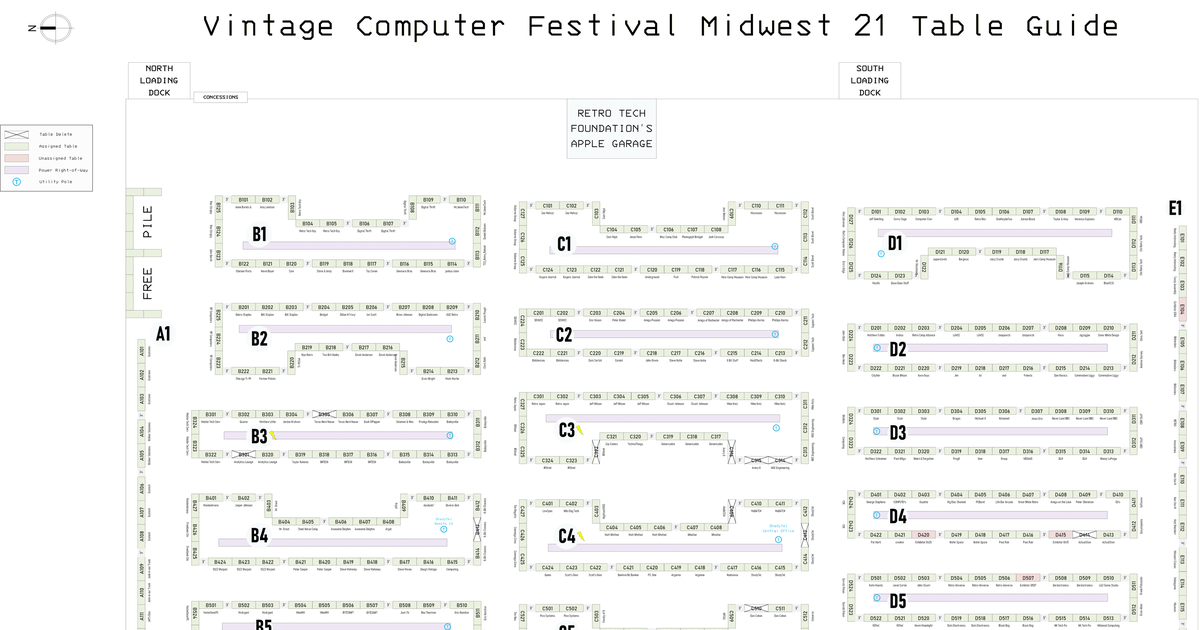
Come check our talk at Saturday 10:30 AM at VCF Midwest!
@mcjonestech@oldbytes.space and I will be discussing the Seequa Chameleon, a quirky PC luggable from the early 80's that had an 8088 and Z80 CPU.
Come see our exhibit, too!
https://geerlingguy.github.io/vcfmw21-map/#079
I'll have a collection of light pens for various systems on display, as well as a working light pen you can play with on an IBM 5150.
And I'll have floppy stickers!
#retrocomputing #vintagecomputing #vcfmw2026

LOL, someone here has a TRS-80 Model 4 stash....(for sale) #vintagecomputing #trs80
Boosted by @trending@homestead.social
Prediction: Now that modern computing is going the way it goes (pricing, "AI", the bunch of rich ignorants running the show), I guess we are going to see another renaissance of #vintagecomputing #permacomputing and #retrocomputing. And I’m absolutely and utterly here for that.
Your NES can show you the planes flying over your house! #retrogaming #nes
The earliest star of the dotcom boom wasn't Amazon or Nvidia. It was Netscape, and the stock went boom on the IPO, but Netscape went boom when it crashed into the ground. https://dfarq.homeip.net/netscape-the-ipo-that-went-boom-on-its-way-up-and-down/ #retrocomputing #vintagecomputing